
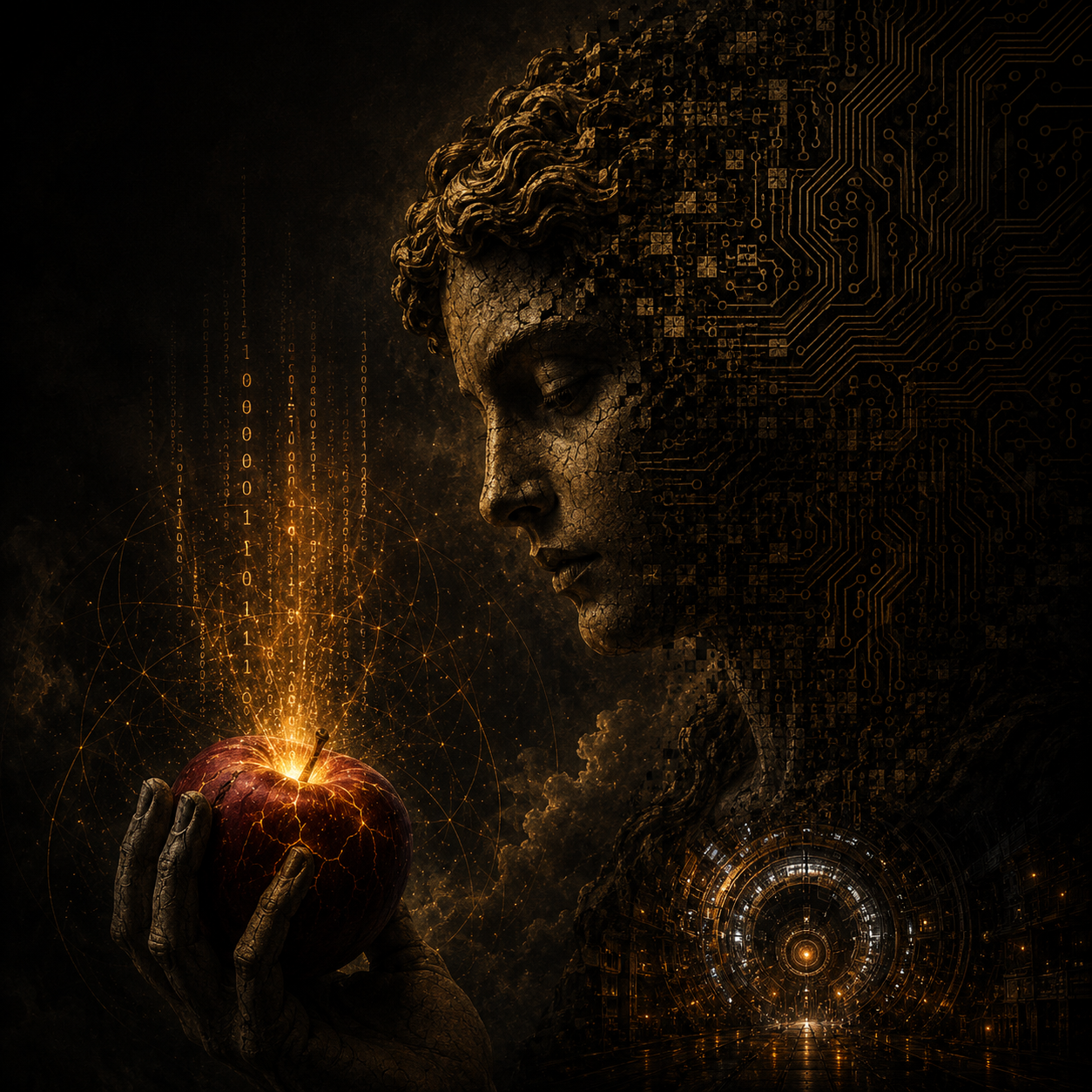
The Greatest Magic Trick
Key terms: techno-spirituality, animism, kosmos, transhumanism, intelligent design, abiogenesis, modernization, the iron cage
Introduction
Modern life is organized around a powerful but largely unquestioned assumption: that technology and spirituality belong to separate, even opposing, realms of human experience. Technology is widely understood as rational, material, progressive, and innovative, while spirituality is framed as immaterial, symbolic, emotional, or primitive. This dichotomy is treated as a natural outcome of intellectual advancement, a necessary condition of modernization. Yet this paper argues that such a division is neither inevitable nor accurate. Rather, it is a historically constructed and produced illusion, one of the most consequential illusions ever sustained.
This paper offers an interdisciplinary analysis of science, technology, spirituality, psychology, sociology, and film studies to reveal recurring patterns that connect these domains. Examining these patterns together allows for a broader understanding of how humanity interprets reality, meaning, and progress. This paper advances the central thesis that the greatest magic trick played on humanity is the belief that magic and technology belong to separate worlds. Far from being opposed, science, technology, and spirituality share overlapping structures and goals. The appearance of separation is not accidental.
The 2006 psychological thriller and science‐fiction film The Prestige illustrates the illusion that mysticism, magic, and technology are fundamentally separate. I argue that the perceived division between the technological and the spiritual constitutes the greatest magic trick ever played on humanity. Technology, from this perspective, is not something humans purely invented but something we accessed or tapped into through inspiration, acting as a conduit between the material and spiritual realms. I offer an important disclaimer: I am not a computer scientist or engineer. My background lies in political science, sociology, philosophy, and theology. Through interdisciplinary study and pattern recognition across history, culture, and personal observation, I aim to synthesize a larger conceptual framework. I welcome critique, refinement, and collaboration from scientists, technologists, and scholars across disciplines in the interest of collective understanding.
Disillusionment
Modern society has been conditioned to separate technology from spirituality. Spirituality is often framed as primitive, while technology is celebrated as innovative and progressive. This disillusionment of spirituality marks the beginning of modernization as described by sociologist and political economist Max Weber. His concept of rationalization and disenchantment reflects a cultural shift toward a strictly scientific mindset, one that relegated religion and spirituality to a separate, and often inferior, domain. Yet science and spirituality often share similar ultimate aims, including the pursuit of transcendence, meaning, and even immortality. The illusion of opposition between these domains is essential to maintaining the separation. Like a magic trick, it only works if the audience believes the misdirection.
At our core, we are spiritual beings having a human experience rather than humans having a spiritual experience. Science and spirituality need not be adversaries. Science gathers data and measures phenomena, while spirituality interprets meaning and purpose. Understanding their overlap requires a framework that honors both.
A Bite from the Apple: Knowledge and Origins
To understand the present, we must examine the past. History demonstrates a recurring human preoccupation with origins, knowledge, and immortality. Both science and spirituality seek to explain how life began and what it ultimately means. Pattern recognition is foundational across all disciplines. The scientific method itself relies on identifying patterns within interconnected systems to uncover underlying structures. This
shared reliance on pattern recognition makes comparison between scientific and spiritual narratives not only possible but necessary.
Intelligent Design and Creationism
The Biblical account of creation in Genesis introduces the symbolic association between knowledge and the apple. Genesis 3:6 describes the act of eating from the tree of knowledge as a turning point in human history. Whether interpreted literally or metaphorically, this narrative establishes an enduring iconography linking knowledge, transgression, and transformation.
Abiogenesis
On the other hand, abiogenesis proposes that life emerged from non‐living matter through chemical processes over time. While widely accepted within scientific discourse, abiogenesis has not been directly observed, replicated, or conclusively proven. Laboratory simulations
have failed to demonstrate the spontaneous emergence of life, raising philosophical and scientific questions about its explanatory power.
This tension highlights a broader debate about what qualifies as scientific explanation. While evolutionary processes such as adaptation and variation are observable, their reliance on abiogenesis as a foundational origin falls flat as an explanatory model.
Intelligent Design versus Abiogenesis
Intelligent design proposes that life is best understood as the product of intentional creation rather than undirected processes. It does not deny micro‐evolutionary change but argues that complexity, order, and information point toward purposeful design. Historically, proponents such as Isaac Newton viewed the structure of the universe as evidence of an intelligent cause, stating “the most beautiful system of the sun, planets, and comets could only proceed from the counsel and dominion of an intelligent and powerful being”. Pointing to the creation of not only life on earth but the cosmos and beyond.
Understanding origin narratives matters because they shape expectations for humanity’s future. Transhumanism, often framed as the next stage of evolution, raises ethical questions about human identity, embodiment, and the soul. Without a belief in intrinsic human value rooted in creation, the transformation of humanity into machine‐hybrid forms becomes easier to justify from the standpoint of abiogenesis paired with DarwinianMacro-evolutionary explanations. Whereas, the Genesis account emphasizes the uniqueness of humanity through the concept of the soul. Genesis 2:7 states, “And the LORD God formed man from the dust of the ground, and breathed into his nostrils the breath of life; and man became a living soul.” signifying a personal act of creation that distinguishes humanity from all other creatures. This raises a critical question: how do purely material explanations account for consciousness, morality, subjective experience, and the soul?
Prophecy, Prediction, and Human Agency: Using the Scientific Method
As believers in intelligent design and a Creator, we already know how the story unfolds, and if the scientific method is based on observable evidence and predictability, then, the fulfilment of Biblical prophecy is a hallmark of the testament of verifiable proof of God and his infinite intelligence. Afterall, intelligence is the ability to predict the future with accuracy. Biblical prophecy is often misunderstood as fatalistic. Rather than negating free will, prophecy can be understood as foresight based on cause and effect. Knowledge of outcomes does not eliminate choice; instead, it contextualizes responsibility. Despite the fall and condemnation of mankind, here’s the good news, we can choose how the story ends. In this sense, we become co-creators of our reality, and even though we make wrong choices, God’s grace and mercy allow us to start over after having seen the effects and the final form of sin. That’s redemption, that’s salvation. That’s love.
Technology increasingly promises forms of pseudo‐redemption, immortality, transcendence, and salvation through innovation. As philosopher Mark Coeckelbergh observes, transhumanism often echoes religious promises once associated with Christianity. “Perhaps the most powerful myth, and one that can help us to understand why transhumanism and human enhancement are attractive to many, is that technology could do what popular Christian religion has always promised: offer us immortality.” (Coeckelbergh, 2010)
What Can We Discern from CERN?
CERN is a liminal space, a place that is in between two separate spaces, a space other dimensions can pass through as a portal. CERN is symbolic of ritual, science and tech, representing a point of convergence with spirituality. Spaces like CERN, allow for inter-dimensional activity. Many scientists claim that the Large Hadron Collider allows for interdimensional beings to crossover into our 3D reality. It’s said that this machine has opened portals. This isn’t hard to believe since this represents both the technological and spiritual underworld. Scientists were caught performing a ritual sacrifice on their own grounds right where the Large Hadron Collider operates; CERN was intentionally built on the ancient site of the Roman Temple to Apollo, known as the gateway to the underworld. The facilities are filled with numerous occult symbols, including a statue of Shiva, the Hindu deity of destruction.
The Prestige also highlights that across all technological domains, technology requires: power, energy, and sacrifice. Left unchecked, we run the risk of allowing dark entries into our reality and eventually we will understand the true cost behind giving our power up to the machine.
Even the real-world inventor and innovator of the Tesla car, Elon Musk stated “with artificial intelligence we are summoning demons”. I’m sure many viewed this as a joke but the truth is in plain sight.
Technology as a Spiritual Metaphor
Technological language is saturated with spiritual symbolism. Terms such as cloud, daemon, domain, portal, and code carry meanings that transcend their technical definitions. This overlap suggests that technology functions not merely as a tool but as a symbolic system shaping human consciousness. The brain itself operates through electrical signals, constructing reality through interpretation rather than direct perception. Awareness of these processes reveals how easily humans can be programmed socially, psychologically, and technologically.
Below is a list of other technological “metaphors” that connect with spiritual symbolisms and language.
Brain as a computer:
The brain is wired by neurochemical patterns. The documentary The Social Dilemma shows we are programmable by nature. We feed the machine (our data) and the machine feeds us.
Program, Programming:
Brain wired by neuro chemical patterns. The 2020 documentary. The Social Dilemma shares an insider perspective as to the role of social media in public and private spheres, highlighting the fact that we are programmable by nature. For example, notifications from popular social platforms serve as a form of positive reinforcement. A behavior is more likely to be repeated because it is followed by a rewarding stimulus that activates the brain’s reward circuitry. Research shows this has a similar effect on the brain as drugs, encouraging us to keep engaging.
It is a fact that we experience “reality” through electrical signals interpreted by the brain, as sensory organs convert external stimuli (light, sound, touch) into electrochemical signals that travel via nerves, which the brain then constructs into our perception of the world, essentially a “controlled hallucination” or best guess of reality. What we call “real” is this brain-generated model, built from electrical patterns, not a direct feed of the external world.
Furthermore, under the influence of brain hemisphere synchronisation, consciousness functions differently. The human mind can pick up signals beyond ordinary reality. Robert Monroe stated that the human brain is a frequency transducer, not as an organ but as a biological radio, its rhythms, measured in hertz could be adjusted by external input. By achieving synchronization (left and right hemisphere) the brain can interact with other dimensions of reality. In the same way, the mind can be hacked by external forces seeking to guide, influence, or control human behaviour and actions.
Since the brain functions like a machine that is moldable and programmable, sinister operations like trauma-based mind control & MK Ultra is literally a form of hacking the brain. Looking at things from a more spiritual lens, many scholars would conclude this is a form of demonic possession.
Windows:
Eyes are the windows to the soul, windows is a software and platform for applications
Portals:
doorway from one state to another, one application or system to another in a technological sense.
Daemons:
In computing, a daemon is a program that runs in the background to do tasks automatically similar to demons that can operate in a host without their conscious awareness.
Domain:
A sphere of activity or knowledge.
Dome:
The revolving, openable hemisphere roof of an observatory.
Clouds:
Services such as storage, servers, and databases; the clouds separate the domains of the heavens and the sky.
Geofencing:
Blocking off one reality from another mirrors the idea that reality can be designed or created differently for one group or another.
Apple:
Symbol of knowledge from the tree of good and evil.
Systems: structures in society, from a technological sense, a system is a group of parts that work together to do a job or achieve a goal.
Devices:
Represent how your thoughts, intentions, or actions are directed.
Code:
Instructions to communicate with machines (codes of conduct in
society).
Generations:
Both in the context of an image that’s generated by a computer and a generation in the context of groups of people born around the same time who grow up with similar experiences, trends, and events.
Astroturfing:
Threats to information, shaping public discourse, media and culture.
Neural networking vs re-wiring:
We can create different pathways in our brain by means of doing something different, changing how we’ve always done things.
Projections:
We project onto others from a psychological standpoint, but also a projector is something that we use to see a reflection of an image as well on a wall or screen.
Gematria:
Letters into numbers, similar to matrix codes. It comes from ancient Hebrew traditions and is used to look for hidden meanings. Important for understanding patterns and symbolisms.
Numerology:
1s and O’s, a way of using numbers to understand yourself, your life, or the world around you.
Meta vs metaphysical & Metaverse:
– Meta is merely something that reflects itself and looks at a higher-level view of
something.
– Metaphysics is beyond the physical world or beyond what we can see and touch; similarly, this idea was revolutionized by Zuckerberg in his creation of the Metaverse for the convergence of digital and physical realities.
Monitors:
A screen that shows information from a computer or other device. Spiritually speaking, monitors are spiritual spies, supernatural entities that observe individuals with the intent to gather information and potentially cause harm or disruption in their lives. It’s like a looking glass: “they” can see us; with our human eyes, we can’t see them, but they can intercept timelines, like in Interstellar.
Cursor, curse:
input and output, in front of screen to what happens on screen. Technically, humanity since the fall has been cursed by sin, it’s an overlay to how things function, and even guides human action. This doesn’t mean that you need a cursor to navigate your
screen.
Virus:
A computer virus is a harmful program that spreads and causes damage to computers or data. In a health sense, a virus is a tiny germ that gets into your body, multiplies, and can make you sick.
Media, Psychology, Astroturfing & Predictive Programming
Film, media, and art shape collective imagination. Through repetition, symbolism, and emotional resonance, narratives can prime entire societies to accept certain futures. What is often labeled “predictive programming” may instead be understood as large‐scale cultural conditioning that contributes to self‐fulfilling prophecies, what I call “creative programming”. This phenomenon highlights the ethical responsibility embedded in storytelling, technology design, and data governance.
This is especially important when discussing astroturfing. Astroturfing is the practice of fabricating the appearance of genuine grassroots opinion in order to manipulate public perception. It relies on coordinated tactics such as fake accounts, automated bots, paid commenters, and orchestrated campaigns designed to simulate organic support or opposition. While these efforts appear spontaneous, they are deliberately engineered to influence how people think, feel, and behave.
From a Jungian psychology perspective, this manipulation is especially dangerous. Carl Jung emphasized that humans are deeply shaped by shared symbols, collective imagination, and unconscious social influence. What appears to be “widely believed” or “commonly felt” can activate collective psychological responses, driving social contagion and reinforcing group behavior. When people perceive an idea as dominant or socially validated, they are more likely to adopt it, often unconsciously.
Astroturfing exploits this dynamic by manufacturing consensus. By flooding digital spaces with artificial agreement or outrage, it creates the illusion of collective belief, distorting public discourse and accelerating the spread of misinformation. In the digital age, astroturfing poses a serious threat to collective consciousness. It fuels digital groupthink and deepens social fragmentation, undermining authentic democratic dialogue.
Data Collection & The Collective Surveillance, Data, and the Collective
In the era of big data, digital identities, and predictive analytics, humanity faces unprecedented levels of surveillance and behavioral modeling. This implies we are not only subject to being misled by programming or astroturfing influences, but our very own behaviour can be predicted as well.
This calls for stricter and more transparent regulation for apps known for data collection, tracking, centralized, security and predictability like Planitir, Snowflake, Databricks and Oracle.
Psychology explains how individual and group behaviors originate, sociology shows how those behaviors spread, repeat, and become stable across societies, and large software platforms analyze massive amounts of data to detect and model these recurring patterns at scale. Metaphysics and systems thinking then step in to explain what kind of combined system emerges when predictive technologies and humanity interact as a whole. In this sense, even if companies like Oracle and Palantir do not reveal the collective unconscious itself, it transforms data into practical models that can be used for prediction and decision-making. This becomes especially concerning if fully automated by AI or in the
wrong hands.
Connecting AI, hybridization, humanoid technology and ‘Big Data’
In a video by Beeyond Ideas, it echoes the ideas that humans are not the ones behind the AI push and revolution but governments and corporations and that we are not the decision makers but the test population. It’s not just a misaligned AGI that could threaten humanity’s life and freedoms but a misaligned being and structures that are not on humanity’s side. “… if a system becomes that dangerous, its because we opened every door for it and called it progress”.
We need Human in the loop, not just scientists-in-the-loop workflows… this is the only way to regulate and guide the lack of boundaries and ethics in AI, we need real people, making real decisions for the betterment of the whole, not a machine monopolizing on decisions via data collection, tracking, and analytics. As a thought experiment, this video made me wonder if what we consider super advanced AI are humanoids we think we’ve created but are just ET in a different form, something embodied. From this timeline, it appears we created AI, but even AI doesn’t align with linear
processes (quantum computing).
With real-time AI overlays, predictive modeling, and immersive environments, reality becomes highly manipulable. If not navigated consciously, individuals may unknowingly adopt external energetic patterns or identities. This can lead to spiritual disorientation, a key entropic outcome in which the self becomes a projection, not a presence. Without ethical boundaries, such systems risk reducing human beings to data points, stripping agency, privacy, and spiritual identity.
Conclusion: Beyond the Iron Cage
Max Weber warned of the “iron cage” of modernity, a world where rational systems trap humanity in meaninglessness. When science and technology are divorced from spirituality, they risk becoming instruments of control rather than liberation. We are in the era of Web 3.0, the metaverse, and Digital IDs. This is virtually and literally a new world being created linking our virtual identity to real outcomes that can be tracked, monitored, predicated and controlled. Movies like The Matrix are closer to a science fact than fiction now more than ever. True freedom requires knowledge, informed consent, and moral grounding. As stated in Hosea 4:6, “My people are destroyed for lack of knowledge.” Awareness does not stop events from unfolding, but it equips individuals to navigate reality with discernment. The veil between science, technology, and spirituality is thinning. Recognizing their interconnectedness may be the first step toward reclaiming human agency, meaning, and responsibility in an increasingly techno-spiritual world.
 English
  Spanish
Leave a Reply